Let’s be real—international shopping is the best feeling ever. Scrolling through a European fashion site, grabbing a Japanese skincare set, or snagging a British home decor piece that’s impossible to find locally? Pure joy. But there’s one thing that always ruins the mood: realizing you overpaid because you didn’t check the exchange rate, or falling for a sneaky fee you didn’t see coming. I’ve been there—stayed up late during a sale, clicked “checkout” without a second thought, and woke up to a credit card bill that was way higher than I expected. That’s why a currency converter for international shopping is non-negotiable for anyone who loves shopping from global stores. It’s not just a tool—it’s your shopping sidekick that saves you cash, avoids traps, and makes every international purchase stress-free.
I used to think currency converters were just for travelers, but once I started shopping internationally more often, I quickly learned how wrong I was. A random converter I found online gave me outdated rates, so I thought a $100 USD dress from a French site would cost me around $107, but my bill ended up being $115—thanks to hidden fees and a bad exchange rate. That’s when I started using a proper currency converter for international shopping, and it changed everything. Now, I use it before adding anything to my cart, before checking out, and even to compare prices across different international sites. It’s easy, it’s free, and it takes 10 seconds tops to use. In this guide, I’m going to break it down for you like a friend—no jargon, no confusing steps, just simple, practical tips that work for real shoppers, whether you’re a casual buyer or a die-hard shopaholic.
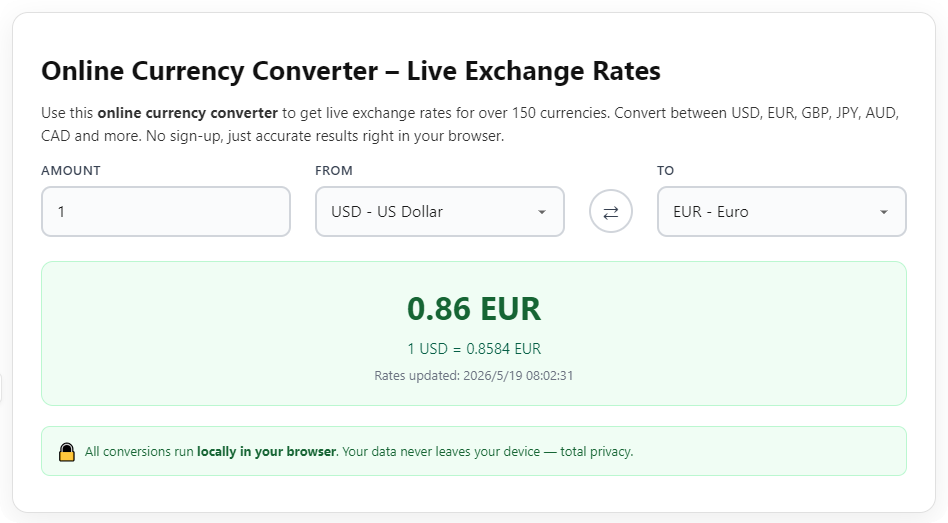
First, let’s clear up a common myth: a currency converter for international shopping isn’t just a “calculator” for converting dollars to euros or yen. It’s a tool that helps you understand the real cost of your purchase—including hidden fees, dynamic currency conversion (DCC) traps, and markup rates that stores don’t tell you about. Exchange rates change every second, and stores often use outdated or inflated rates to make extra money. With a good converter, you’ll always know the real value of your purchase in your home currency, so you can decide if it’s worth buying, avoid overpaying, and shop with confidence.
Why Every International Shopper Needs a Currency Converter for International Shopping
You might be thinking, “Do I really need a currency converter for international shopping? Can’t I just trust the price the store shows in my home currency?” Trust me—I’ve made that mistake, and it’s cost me more than I want to admit. A currency converter for international shopping is a must-have for any global shopper, and here’s why:
• It helps you avoid DCC traps (the biggest shopping scam!): Dynamic Currency Conversion (DCC) is a sneaky trick where stores or payment processors offer to charge you in your home currency instead of the local one. It sounds convenient, but it comes with a terrible exchange rate and hidden fees—costing you 3–7% extra on every purchase[1][5]. A currency converter lets you check the real rate, so you can say “no” to DCC and pay in the local currency, saving you cash on every order.
• It shows you the real cost (no more surprises): Many international stores display prices in your home currency, but they use inflated exchange rates to make extra money. For example, a dress priced at €80 on a French site might be shown as $95 USD, but the real exchange rate would make it $85 USD—you’re overpaying $10 without even realizing it[3][5]. A currency converter for international shopping gives you the real-time rate, so you know exactly how much you’re paying.
• It helps you compare prices across global sites: Want to buy a skincare set, but not sure if it’s cheaper on a Japanese site or a Korean site? Use your converter to convert both prices to your home currency, and you’ll instantly see which one is a better deal. No more guessing—just smart shopping.
• It saves you from double fees: If you use a dual-currency credit card, you might get hit with a 1.5–3% currency conversion fee when you pay in a foreign currency[6]. A currency converter helps you calculate that fee upfront, so you can decide if it’s better to use a no-fee credit card or adjust your purchase to save money.
• It works on the go (perfect for sale season!): The best currency converters for international shopping are mobile-friendly, so you can use them while scrolling through sites on your phone—whether you’re on the couch, at work, or waiting in line. No more waiting until you’re on your laptop to check the rate—you can shop smart anytime, anywhere.
And the best part? A good currency converter for international shopping is 100% free. No signup, no hidden fees, no ads—just a simple tool that works exactly when you need it.
Step-by-Step: How to Use a Currency Converter for International Shopping (Like a Pro)
Using a currency converter for international shopping is easier than you think. I’m going to walk you through the exact steps, using a simple, shopping-friendly converter (the kind that’s free, ad-free, and works on your phone). These steps work for any good currency converter, so no matter which one you choose, you’ll be able to use it like a pro. We’ll cover everything from pre-cart checks to checkout hacks, so you’re ready for every international shopping scenario.
Step 1: Pick the Right Currency Converter for International Shopping (1-Time Setup)
First, you need to choose a currency converter that’s designed for international shopping—because not all converters are the same. Some are slow, some have outdated rates, and some are cluttered with ads that ruin your shopping flow. Look for these key features to make sure it’s right for you:
• Free, no signup required (you don’t want to waste time creating an account when you’re in the middle of a sale).
• Real-time exchange rates (updates every 1–60 seconds, so you get the most current rate—critical for shopping, since rates change fast).
• Supports hundreds of currencies (from major ones like USD, EUR, and JPY to less common ones like GBP, AUD, and KRW—perfect for shopping from any country).
• Simple, mobile-friendly interface (easy to use on your phone, with big buttons and clear results—no squinting at tiny text while shopping).
• Optional fee calculator (some converters let you add credit card fees or DCC markup to see the total cost—super useful for avoiding surprises).
Once you find the right one, bookmark it on your phone’s browser or add it to your home screen. This one-time setup will save you tons of time later—no more searching for “currency converter” every time you’re shopping internationally. I keep mine on my home screen, and I use it at least once a day during sale season.
Pro tip: Avoid converters that ask for your email, require you to download an app (unless it’s 100% free and ad-free), or have tons of ads. Those will just slow you down and ruin your shopping experience. The best currency converters for international shopping are simple, clean, and focused on what you need—fast, accurate conversions.
Step 2: Use It Before Adding Items to Your Cart (Avoid Impulse Buys!)
One of the best ways to use a currency converter for international shopping is to check the price before adding items to your cart. This helps you avoid impulse buys and ensures you’re not overpaying for something that’s cheaper locally or on another site. Here’s how to do it:
1. Find an item you want to buy on an international site (e.g., a €60 dress on a French site, a ¥5,000 skincare set on a Japanese site).
2. Note the price in the local currency (the currency the site uses—usually listed at the top of the page or next to the item price).
3. Open your currency converter, enter the local currency amount, select the local currency as “From,” and your home currency as “To.”
4. Check the converted amount—this is the real cost of the item in your home currency (before shipping and taxes).
For example: Let’s say you’re shopping on a British site, and you find a £40 sweater. Your home currency is USD. Open your converter, enter “40,” select “GBP” (From) and “USD” (To). If the live rate is 1 GBP = 1.27 USD, the result is $50.80. Now you know the sweater will cost you around $50.80 (plus shipping and taxes)—if that’s within your budget, add it to your cart; if not, skip it.
Pro tip: If you’re comparing prices across multiple international sites, convert all prices to your home currency using the same converter (to ensure consistency). For example, a €50 bag on a German site vs. a £45 bag on a British site—convert both to USD, and you’ll see which one is cheaper. This is how I saved $20 on a handbag last month!
Step 3: Use It at Checkout (Avoid DCC Traps & Hidden Fees)
The most important time to use a currency converter for international shopping is at checkout. This is where most shoppers get scammed—either by DCC or hidden fees. Here’s how to use your converter to stay safe:
1. When you get to checkout, the site will ask you to choose a payment currency—usually the local currency (e.g., EUR for a French site) or your home currency (e.g., USD).
2. Before choosing, open your converter and check the real-time rate for the local currency to your home currency.
3. If the site offers to charge you in your home currency, compare that amount to the converted amount from your converter. Chances are, the site’s rate is inflated (DCC), and you’ll pay more[1][5][6].
4. Always choose to pay in the local currency—this way, your credit card company will use the real exchange rate (not the site’s inflated one), and you’ll save money.
Example: You’re buying a €80 dress on a French site. The site offers to charge you $88 USD (DCC rate) or €80 (local currency). Your converter shows that €80 = $85.60 (live rate: 1 EUR = 1.07 USD). By choosing to pay in EUR, you save $2.40—small, but it adds up if you’re buying multiple items.
Pro tip: Some sites hide the DCC option in a small checkbox or dropdown menu—keep an eye out for phrases like “pay in your home currency,” “guaranteed rate,” or “dynamic currency conversion”[1]. Uncheck that box and select the local currency—your wallet will thank you. Also, if you’re using a credit card with foreign transaction fees, use the converter to calculate the fee (e.g., 2% of $85.60 = $1.71) so you know the total cost upfront[6].
Step 4: Use It to Calculate Total Cost (Including Shipping & Taxes)
One mistake many international shoppers make is forgetting to factor in shipping and taxes—these can add 10–30% to your total cost. A currency converter for international shopping helps you calculate the total cost upfront, so you’re not surprised by a huge bill. Here’s how:
1. Add the item price, shipping cost, and any taxes (listed on the checkout page) in the local currency.
2. Enter the total amount into your converter, select the local currency as “From,” and your home currency as “To.”
3. The result is the total cost of your order in your home currency—this is the amount that will be charged to your credit card (plus any credit card fees).
Example: You’re buying a ¥10,000 Japanese skincare set. Shipping is ¥1,500, and taxes are ¥800. Total in JPY: 10,000 + 1,500 + 800 = ¥12,300. Your converter shows 1 JPY = 0.0067 USD. Total cost in USD: $82.41. Now you know exactly how much you’ll pay—no surprises.
Pro tip: Some international sites offer free shipping over a certain amount (e.g., free shipping on orders over €100). Use your converter to calculate how much more you need to spend to qualify for free shipping—sometimes adding a small item is cheaper than paying for shipping. For example, if you’re at €90, adding a €10 item (converted to $10.70) is cheaper than paying €15 shipping (converted to $16.05).
Step 5: Use It to Avoid Double Fees (Credit Card Hacks)
If you use a credit card for international shopping, you might be hit with double fees: currency conversion fees (1.5–3%) and DCC fees (3–7%)[6]. Acurrency converter for international shopping helps you avoid these fees and save even more. Here’s how:
1. Use a no-foreign-transaction-fee credit card—this eliminates the 1.5–3% conversion fee.
2. Use your converter to check the real rate, then pay in the local currency (avoid DCC) to skip the inflated rate and DCC fees[1][5][6].
3. If you don’t have a no-fee card, use the converter to calculate the total fee (conversion fee + DCC fee) and decide if the purchase is worth it. For example, a $100 purchase with a 2% conversion fee and 5% DCC fee would cost you an extra $7—if the item is only $5 cheaper than local stores, it’s not worth it.
Pro tip: Some credit cards offer rewards or cashback for international purchases—use your converter to calculate the net cost after rewards. For example, a 3% cashback card on a $100 purchase would give you $3 back, offsetting a 2% conversion fee.
Real-Life Shopping Scenarios: Using a Currency Converter for International Shopping
Let’s put these steps into action with real international shopping scenarios you’ll actually encounter. This will show you just how useful a currency converter for international shopping is in real life.
Scenario 1: Avoiding DCC on a European Fashion Site (USD to EUR)
You’re shopping on a French fashion site and find a €120 jacket. At checkout, the site asks if you want to pay in EUR or USD (DCC). Here’s how to use your converter:
1. Open your converter, check the live rate: 1 EUR = 1.07 USD. €120 = $128.40.
2. The site offers to charge you $135 (DCC rate)—that’s $6.60 more than the real rate.
3. You select “pay in EUR” (local currency), and your no-fee credit card charges you $128.40—saving you $6.60. That’s enough for a coffee or a small accessory!
Scenario 2: Comparing Prices Across International Sites (USD to GBP vs. USD to JPY)
You want to buy a wireless headphones, and you find them on a British site for £80 and a Japanese site for ¥12,000. You want to know which one is cheaper. Here’s how to use your converter:
1. Convert £80 to USD: Live rate 1 GBP = 1.27 USD → $101.60.
2. Convert ¥12,000 to USD: Live rate 1 JPY = 0.0067 USD → $80.40.
3. The Japanese site is $21.20 cheaper—you buy from there and save big. Plus, you use your converter to check shipping: ¥2,000 = $13.40, so total cost is $93.80—still cheaper than the British site.
Scenario 3: Calculating Total Cost with Shipping & Taxes (USD to AUD)
You’re buying a $150 USD book from an Australian site (local currency: AUD). Shipping is AUD 20, and taxes are AUD 15. Here’s how to use your converter:
1. Total in AUD: 150 (converted from USD) + 20 + 15 = AUD 185. Wait—no, first convert the item price to AUD: 1 USD = 1.52 AUD → $150 USD = AUD 228.
2. Add shipping (AUD 20) and taxes (AUD 15): AUD 228 + 20 + 15 = AUD 263.
3. Convert back to USD to check total cost: 1 AUD = 0.66 USD → AUD 263 = $173.58.
Now you know the total cost is $173.58—you decide it’s worth it, so you complete the purchase. No surprises, no overpaying.
Scenario 4: Avoiding Double Fees with a Dual-Currency Card (USD to EUR)
You have a dual-currency credit card (USD + EUR) that charges a 1.5% currency conversion fee. You’re buying a €70 bag from a German site. Here’s how to use your converter:
1. Check the live rate: 1 EUR = 1.07 USD → €70 = $74.90.
2. Calculate the conversion fee: 1.5% of $74.90 = $1.12.
3. Total cost: $74.90 + $1.12 = $76.02.
4. You remember you have a no-fee credit card, so you use that instead—saving $1.12. Over time, these small savings add up!
Common Mistakes to Avoid When Using a Currency Converter for International Shopping
Even if you have a currency converter for international shopping, it’s easy to make mistakes that cost you money. I’ve made every single one of these, so learn from my errors:
1. Trusting the site’s home currency display: Many international sites show prices in your home currency, but they use inflated rates to make extra money[3][5]. Always check the rate with your converter before buying—don’t just trust the site’s number.
2. Forgetting to factor in shipping and taxes: Shipping and taxes can add a lot to your total cost—always convert the total (item + shipping + taxes) to your home currency to avoid surprises.
3. Falling for DCC: DCC is the biggest trap for international shoppers[1][5][6]. If the site offers to charge you in your home currency, compare it to your converter’s rate—you’ll almost always pay more. Always choose the local currency.
4. Using an outdated rate: Exchange rates change every second—if you leave your converter open for 10+ minutes, the rate might be outdated. Always refresh the rate before converting, especially for large purchases.
5. Mixing up “From” and “To” currencies: This is the #1 mistake! For example, selecting “USD” as “From” when you’re converting EUR to USD. Always double-check—if your result seems way too high or too low, you probably mixed up the currencies.
6. Not using a no-fee credit card: If you use a credit card with foreign transaction fees, you’re throwing away money[6]. Use your converter to calculate the fee, and switch to a no-fee card if possible.
Pro Tips to Get the Most Out of Your Currency Converter for International Shopping
Now that you know how to use a currency converter for international shopping, these pro tips will make you a shopping pro—saving you even more money and stress:
1. Save your favorite currency pairs: Most converters let you save your most used currency pairs (e.g., USD to EUR, USD to JPY) so you don’t have to select them every time. This saves you time when you’re shopping from your favorite international sites.
2. Set rate alerts: Some converters let you set alerts for when the rate reaches a certain level. For example, if you want to buy a €200 bag when 1 EUR = 1.05 USD (to save money), set an alert and get notified when the rate hits that mark. This is perfect for big-ticket items.
3. Copy results to your clipboard: If you’re keeping a shopping budget or comparing prices, use the converter’s “Copy” button to paste the converted amount. This saves you from typing it manually and making a mistake.
4. Use it to plan sales: During big sales (like Black Friday or Cyber Monday), international sites often have great deals—but exchange rates can fluctuate. Use your converter to check the rate before the sale, and monitor it leading up to the sale to get the best deal[3].
5. Test with a small purchase first: If you’re shopping on a new international site, make a small purchase first (e.g., $20) and use your converter to check the final bill. This way, you can verify that the site isn’t charging hidden fees or using inflated rates.
Frequently Asked Questions (FAQ) – Shoppers’ Most Common Questions
Q: Do I need to download an app to use a currency converter for international shopping? A: No! Most good converters work right in your browser—no downloads, no signup. Just bookmark it on your phone, and you’re good to go. If you prefer an app, look for free, ad-free options with real-time rates, but a browser-based converter is usually easier for shopping.
Q: Are currency converters for international shopping accurate? A: Yes—if you use a good one with real-time rates. They use the same mid-market rate that banks use, so you’ll get an accurate benchmark. Just remember that the rate you get from the site (if you pay in your home currency) will be inflated (DCC), but the converter helps you compare and avoid that[1][4][5].
Q: Can I use a currency converter for international shopping offline? A: Yes! Most good converters let you save the latest rates for offline use. Just update the rates before you lose Wi-Fi (like at home or a café), and you can convert anytime—perfect for shopping on the go or in areas with spotty internet.
Q: Do I need to use it for small purchases (under $50)? A: It’s up to you! For small purchases, the difference might be $1–2, which might not be worth the time. But for larger purchases (over $50), it’s definitely worth using—saving $5–10 adds up over time. I use mine for all purchases over $30, just to be safe.
Q: What if the site only shows prices in the local currency? A: That’s actually better! Just use your converter to convert the local currency price to your home currency—you’ll get the real rate, and you won’t be tempted by DCC. Most international sites let you switch to the local currency if they’re showing your home currency—look for a currency selector at the top of the page[2][7].
Final Thoughts – Why a Currency Converter for International Shopping Is a Must-Have
International shopping should be fun, not stressful. A currency converter for international shopping takes the guesswork out of global purchases, saves you money, and helps you avoid the sneaky traps that stores use to overcharge you. Whether you’re buying skincare from Japan, fashion from Europe, or home decor from Australia, this tool is your best friend.
The key takeaway? Don’t overcomplicate it. Pick a simple, shopping-friendly converter, bookmark it, and use it before adding items to your cart, at checkout, and to calculate total costs. Avoid DCC, use a no-fee credit card, and factor in shipping and taxes—you’ll be shopping like a pro in no time.
You don’t need to be a financial expert to use a currency converter for international shopping—you just need to know the basics. It’s free, it’s fast, and it saves you money that’s better spent on more international finds. So next time you’re scrolling through a global site, remember to grab your converter—your wallet will thank you, and you’ll be able to shop with confidence, no more surprises, no more overpaying.