If you’ve ever typed “BMI calculator” into your browser and felt overwhelmed by dozens of options—some spammy, some too basic, some just plain wrong—you’re not alone. I’ve been there too: clicked a random tool, plugged in my numbers, got a result that clashed with my doctor’s note, and thought, “Why is this so hard?” The truth is, not all BMI calculators are created equal. For a reliable weight health check, you need the best BMI calculator for weight health check—one that’s accurate, easy to use, free of junk, and built to give you real insights, not just a number.
In this guide, I’ll walk you through exactly what makes a BMI calculator great, share my top trusted picks, and show you step-by-step how to use them for a meaningful weight health check—no confusing jargon, no technical skills required. Whether you’re new to BMI checks or just fed up with bad tools, by the end, you’ll know exactly which tool to use and how to get results you can actually trust.
Why Your Choice of BMI Calculator Matters for Health Checks
Let’s start with the basics: BMI (Body Mass Index) is a quick, widely used screening tool that links your height and weight to potential health risks like high blood pressure, type 2 diabetes, or heart disease. But here’s the catch: a bad calculator gives bad data, and bad data leads to bad decisions.
I’ve seen it happen so many times:
- A friend used a sketchy ad-filled calculator, mixed up metric/imperial units, and thought she was obese—until she used a trusted tool and saw she was in the normal range.
- A family member relied on a generic tool that ignored age, leading to unnecessary worry about his weight as an older adult.
The best BMI calculator for weight health check fixes these problems. It’s built for accuracy, designed for real people, and made to help you understand your weight health—not just scare you or give you a meaningless number.
What Makes the Best BMI Calculator for Weight Health Check?
Before jumping into my top picks, let’s break down the non-negotiable features of a great BMI tool. These are the things I look for every time, and they’re why some calculators stand head and shoulders above the rest.
1. 100% Accurate & Transparent Formula
The gold standard BMI formula is simple: weight (kg) ÷ height (m)². The best tools use this exact WHO/CDC formula, no shortcuts, no weird tweaks. They’re also transparent—they’ll show you how the math works, so you never wonder if the result is made up. Avoid any calculator that hides its formula or says “proprietary algorithm”—that’s a red flag.
2. Supports Both Metric & Imperial Units
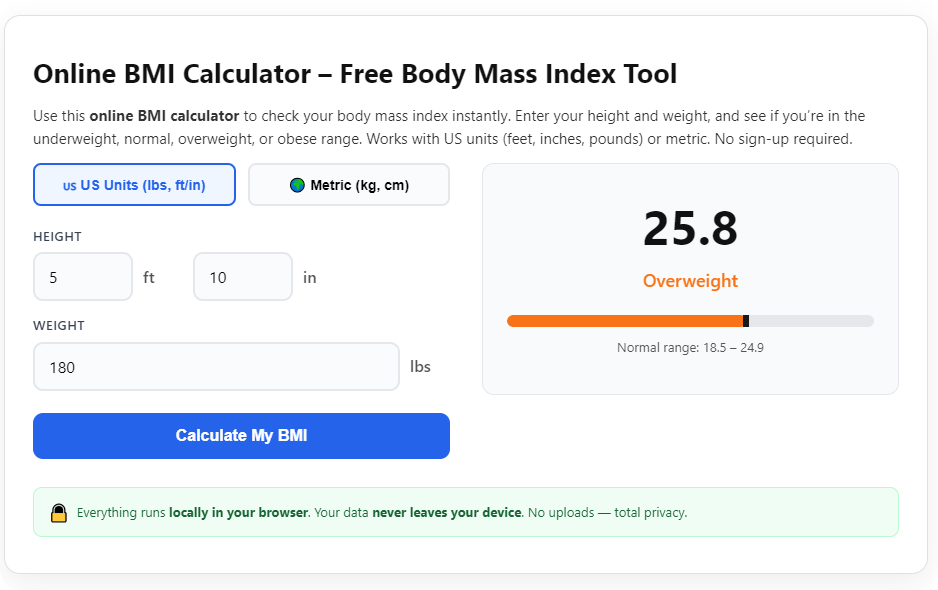
Most of us switch between units without thinking: some use pounds/inches, others kilograms/centimeters. The top calculators let you pick either, auto-convert correctly, and don’t round aggressively (a tiny rounding error can shift your BMI category!). No more guessing or doing math in your head.
3. No Ads, No Sign-Ups, No Junk
A great BMI tool is clean, fast, and focused. It won’t bombard you with pop-ups, ask for your email, or make you create an account. Your weight and height are private—you shouldn’t have to hand over personal info just to check your BMI.
4. Clear, Easy-to-Understand Results
Numbers mean nothing without context. The best calculators don’t just show your BMI—they explain your category (underweight, normal, overweight, obese) in plain English, link it to basic health risks, and even give a healthy weight range for your height. No medical degree required to understand what you’re seeing.
5. Trusted Source (No Random Websites!)
This is huge. The most reliable tools come from government health agencies (CDC, NHS) or reputable health organizations. They’re updated regularly, backed by medical experts, and designed for real health screening—not clickbait.
6. Extra Helpful Extras (Bonus!)
The best tools go the extra mile: some adjust for age/gender (critical for kids, teens, and older adults), others let you track your BMI over time, and a few even add waist circumference tips for a more complete health picture.
My Top 3 Best BMI Calculator for Weight Health Check (Free & Trusted)
After testing dozens of tools, these three stand out as the absolute best for a reliable weight health check. All are free, ad-free, and backed by trusted health authorities—no sketchy sites here.
1. CDC Adult BMI Calculator (Top Pick for Most Adults)
The CDC (U.S. Centers for Disease Control and Prevention) is the gold standard for health tools, and their BMI calculator is perfect for adults aged 20+.
Why I love it: Super clean interface, no ads, uses the exact WHO formula, and gives crystal-clear categories. It also links to detailed guides on BMI limitations (like muscle mass exceptions) so you don’t misinterpret results.
Best for: Adults 20+, anyone wanting a no-fuss, 100% accurate check.
2. NHS BMI Calculator (Great for UK Users & Global Standard)
The NHS (UK National Health Service) calculator is another top-tier option, widely used across Europe and trusted worldwide.
Why I love it: Supports stones/pounds (common in the UK) plus metric/imperial, gives personalized health risk notes, and explains results in simple terms. It’s also mobile-friendly, so you can check on your phone anytime.
Best for: UK residents, anyone who prefers stones/pounds, global users wanting a trusted standard.
3. CDC Child & Teen BMI Calculator (Must-Have for Parents)
If you’re checking BMI for kids aged 2–19, this is the only tool you need. Unlike adult calculators, it uses age- and gender-specific percentiles (comparing your child to peers of the same age/sex) instead of fixed categories—this is critical for growing bodies.
Why I love it: Accurate, easy to use, and shows a growth chart percentile so you can track trends over time. It also clarifies that BMI for kids is about growth, not just weight.
Best for: Parents of kids/teens 2–19, pediatric health checks.
Step-by-Step: How to Use the Best BMI Calculator for Weight Health Check
Now that you’ve got the right tool, let’s walk through exactly how to use it for a reliable weight health check. I’ll use the CDC Adult Calculator as an example, but the steps are almost identical for all top tools.
Step 1: Get Accurate Height & Weight (The Most Important Part!)
A calculator is only as good as the numbers you put in. Skip guessing—measure properly:
- Weight: Weigh yourself first thing in the morning (before eating/drinking), wearing light clothes. Use a digital scale (more accurate than analog). Round to 0.1 kg or 0.2 lbs.
- Height: Stand barefoot against a wall, heels/back/head touching the wall. Measure from floor to top of head with a tape. Round to 0.1 cm or 0.1 inches.
Step 2: Open Your Trusted BMI Calculator
Go to the CDC or NHS website (no downloads needed—works in any browser). Avoid random Google results with weird domain names—stick to official sites.
Step 3: Choose Your Unit System
Pick metric (kg/cm) or imperial (lbs/in) to match your measurements. Double-check this! Mixing units is the #1 mistake people make.
Step 4: Enter Height & Weight
Type in your exact measurements—no rounding up/down. For example, 174.5 cm, not 175; 70.3 kg, not 70.
Step 5: Click “Calculate” & View Results
Hit the button, and you’ll get your BMI number + category in seconds. The best tools also show:
- Healthy weight range for your height
- Brief health risk notes
- Links to more info if you want to learn more
Step 6: Interpret Results (Don’t Panic—Context Is Key!)
BMI is a screening tool, not a diagnosis. Here’s how to read it:
- Underweight (<18.5): May mean low body fat or nutrient gaps—check with a doctor.
- Normal (18.5–24.9): Generally healthy weight for most adults.
- Overweight (25–29.9): Slightly higher risk of weight-related issues—small lifestyle changes help.
- Obese (≥30): Higher risk of diabetes, high blood pressure—talk to a doctor for guidance.
Critical Note: If you’re very muscular (athletes, bodybuilders), BMI may show “overweight” even if you’re healthy—muscle weighs more than fat. Always pair BMI with how you feel and a doctor’s checkup.
Common Mistakes to Avoid (Even with the Best Tool!)
Having the best BMI calculator for weight health check won’t help if you make these easy-to-fix mistakes:
- Guessing height/weight: A half-inch or 2-lb error can shift your category. Measure properly!
- Mixing units: Pounds with centimeters, or kg with inches—double-check every time.
- Using adult tools for kids: Kids need age/gender percentiles, not fixed categories.
- Ignoring BMI limitations: It doesn’t measure muscle, bone density, or body fat location.
- Checking once and stressing: Track BMI over 1–3 months—trends matter more than one number.
Final Thoughts: The Best BMI Calculator Is the One You’ll Use Consistently
At the end of the day, the best BMI calculator for weight health check isn’t about fancy features—it’s about accuracy, trust, and simplicity. The CDC and NHS tools check all the boxes: free, ad-free, backed by experts, and easy enough for anyone to use.
BMI is just one piece of your health puzzle, but it’s a great starting point for understanding your weight and potential risks. By picking a trusted tool, measuring accurately, and interpreting results with context, you’ll get a weight health check you can actually rely on—no more confusion, no more guesswork.
So grab your scale and measuring tape, open the CDC or NHS BMI calculator, and take 2 minutes to check your BMI today. It’s a small step that can make a big difference in your long-term health.